01Detection and tracking are not the same problem
Detection is a yes-or-no question: is there a drone in this airspace. Tracking is a continuous one: exactly where is it now, and where is it going next. Radar, RF direction-finding and acoustic sensing are all strong at the first question. They are built to notice a threat early and push a rough bearing and range. None of them, on their own, gives you a clean, continuous, identify-grade picture of a single small target moving through a busy sky.
That gap matters because nothing downstream works without a track. You cannot positively identify a drone from a radar blip. You cannot judge whether it is a hobbyist who strayed or a threat closing on a protected asset from an acoustic bearing alone. And no effector, kinetic or non-kinetic, can be cued without a precise, stable line of sight held over time. Detection starts the engagement. Tracking is what carries it.
02What the electro-optical layer actually does
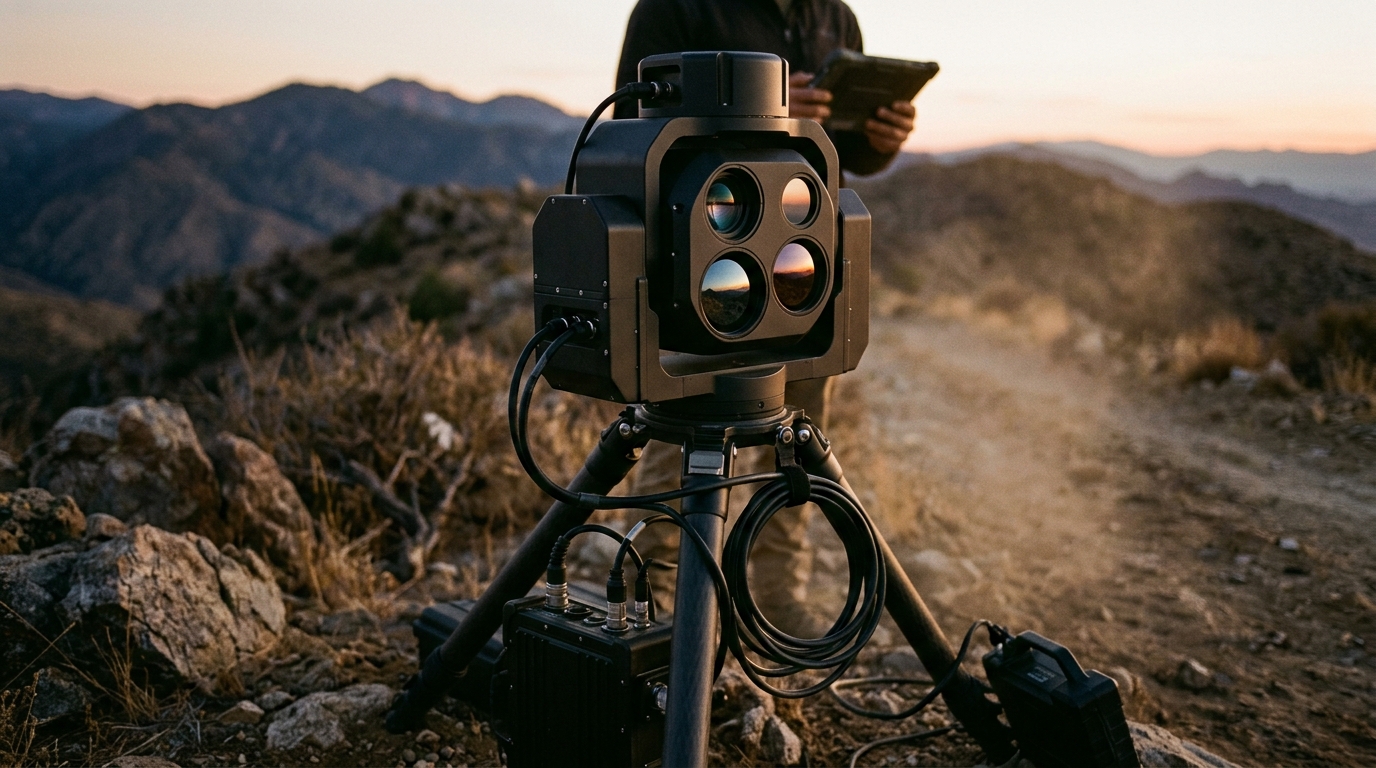
An electro-optical and infrared payload, mounted on a stabilised gimbal, is the sensor that turns a cue into a lock. Given a bearing from radar, RF or an acoustic node, it slews onto that patch of sky, finds the target visually, and then holds it: keeping the drone centred in frame while both the sensor platform and the target move. Modern trackers fuse a visible channel for daylight contrast with a thermal channel for the heat of motors and airframe, so a single track survives from full daylight into night without dropping at dusk.
Three things come out of that continuous lock that no detection sensor can provide on its own. First, positive visual identification: an operator, or a classifier, can see what the object actually is. Second, a precise, low-latency line of sight that updates every frame. Third, a track history stable enough to project where the target is heading, which is what makes an early, informed decision possible instead of a rushed one.
03Why this layer keeps working when others go blind
The threat that defeats a counter-UAS stack is usually the quiet, autonomous one: a small drone flying RF-silent on a pre-programmed route, low and slow against ground clutter. That profile is exactly what blinds RF direction-finding, which needs a signal to home on, and strains radar, which struggles to separate a small, slow target from the background. An electro-optical sensor does not care whether the drone is transmitting. If it can be seen, in visible light or in thermal, it can be tracked. That makes the optical layer one of the few that keeps producing an actionable picture in an electronically contested environment.
04Tracking is a software problem before it is a hardware one
It is tempting to treat this as a question of buying a better camera. It is not. The hard part is the software that holds the lock: detecting the target against a cluttered or fast-moving background, staying locked through occlusion and sudden manoeuvres, re-acquiring after a brief loss, and rejecting the false positives, birds, distant aircraft, moving foliage, that would otherwise break the track or cry wolf. Doing all of that at the frame rate an engagement demands, on hardware that can sit at the edge rather than in a data centre, is where a tracking capability is really won or lost.
It is also where sovereignty matters. A tracking model that has to phone home, or that runs only on infrastructure outside national control, is not deployable at a forward site or inside an air-gapped network. The tracking layer has to run locally, on commodity edge compute, with no assumption of connectivity, and stay fully under the operator's control.
05Where tracking fits in the engagement chain
In a mature architecture the layers hand off in sequence. Radar and acoustic sensors detect early and cue. The electro-optical sensor slews onto the cue, confirms the target, and holds the precise track. That track then feeds identification, the human decision, and, only on that decision, any response. Each layer does the job it is best at, and the whole chain is only as strong as the hand-off between detection and tracking. Get that hand-off right and scattered alerts become one engageable picture. Get it wrong and a stack full of sensors still loses the target at the moment it matters most.
Frequently Asked Questions
What is the difference between detecting and tracking a drone?
Detection answers a yes-or-no question: is there a drone in the airspace. Tracking answers a continuous one: exactly where is it, right now, and where is it heading. Radar, RF and acoustic sensors are strong at detection and cueing, but a stable electro-optical track is what holds a target frame by frame long enough to identify it and act on it.
Why is electro-optical tracking important in counter-UAS?
An electro-optical or infrared sensor gives a continuous visual lock that survives when the drone is RF-silent and hard for radar to hold against clutter. It provides positive visual identification, a precise line of sight, and the stable track a decision-maker and any effector both depend on. Without it, a cue from another sensor has nowhere to hand off to.
Can electro-optical tracking work at night?
Yes. A combined electro-optical and infrared payload tracks in daylight on visible contrast and at night on the thermal signature of the drone's motors and airframe. Fusing both channels keeps a single continuous track across changing light rather than dropping it at dusk.
How does electro-optical tracking fit with radar and acoustic sensors?
They are layers, not competitors. Radar and acoustic sensors detect early and cue a bearing and rough range. The electro-optical sensor slews onto that cue, confirms the target visually, and holds the precise track. Fusing detection sensors with a tracking sensor is what turns a scattered set of alerts into one engageable picture.